Caveat (Form 11)
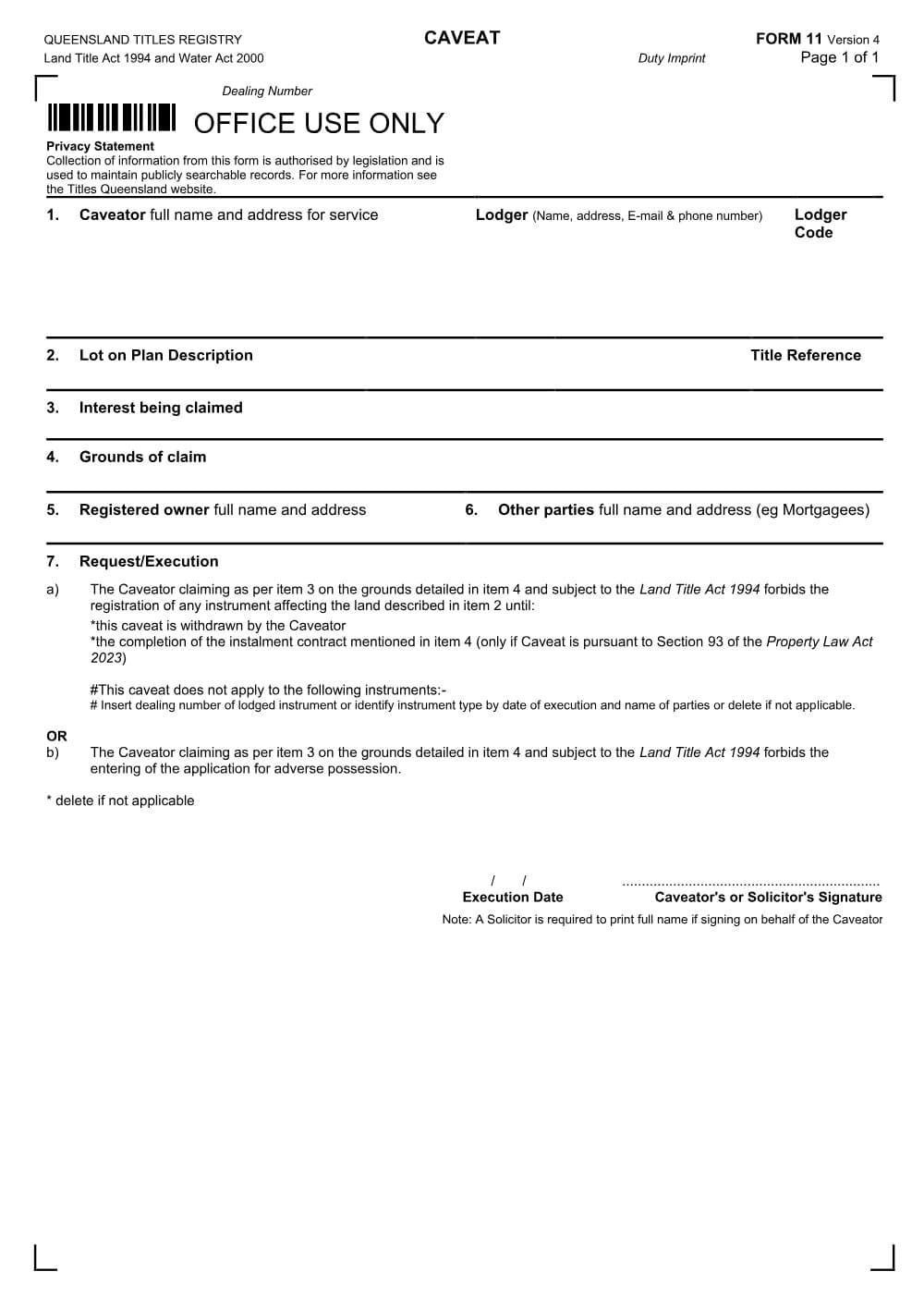
Form 11 is the Titles Queensland caveat that a person claiming an interest in Queensland land lodges to stop other dealings being registered on the title. Word and PDF versions are available.
PDF from Titles Queensland's website.
DraftOur fillable copy of this form has not been through editorial review yet. Check it against Titles Queensland's current form before you rely on it.
- Format
- Word (DOCX)
- Category
- Land titles form
- Form number
- Form 11
- Version
- vc67634f4
- Last verified
- 6 August 2026
Land Title Act 1994
For law practices: this form maps to the published matter-field vocabulary, so your practice management system fills it from your matter data - on your own machine. Practice management systems can fetch and assemble it through the document assembly API.
What Form 11 is for
A caveat is a notice to the Registrar that, from its lodgement time, prevents registration of instruments affecting the lot until it lapses or is withdrawn, removed, cancelled or rejected (s 124 of the Land Title Act 1994 (Qld)), subject to exceptions such as instruments the caveat says it does not apply to or that the caveator consents to. Section 121 sets out what a caveat must contain and requires it to be signed by or for the caveator. Section 122 says who may lodge one: a person claiming an interest in the lot, the registered owner, a person an Australian court has ordered an interest be transferred to, or a person with an order restraining the registered owner from dealing with the lot. Lodging a caveat does not give the caveator a registrable interest (s 124(5)). Form 11 (version 4) is the approved form; practice is in Part 11 of the Land Title Practice Manual (LTPM).
When you need it
- A purchaser under a signed contract wants to protect their equitable interest before settlement.
- A lender or creditor holds a written charge or unregistered mortgage over the land. A caveat by an equitable mortgagee always lapses unless court proceedings are started (s 122(2)).
- Someone claims a lease, option, easement or trust interest in the land, or a purchaser under an instalment contract (s 93 of the Property Law Act 2023).
- A registered owner wants to protect their own interest, or objects to an application for adverse possession (Item 7(b)).
- Not for a bare debt: Items 3 and 4 must show a currently existing legal or equitable interest in the lot (LTPM [11-2020]).
How to fill it in
- 1
Item 1 and the lodger panel
Insert the caveator's full name and an address where documents can be served, which may be a named lawyer's address (s 121(2A)). Add any capacity, such as 'as Trustee'. Complete the lodger's name, postal address and phone number.
- 2
Item 2: the land
Use 'Lot [no.] on [plan]' with the plan prefix and the title reference. A caveat over part of a lot needs a sketch plan that precisely identifies the part.
- 3
Items 3 and 4: interest and grounds
State the interest precisely, for example 'An equitable interest as purchaser of an estate in fee simple', then the grounds with dates and parties, for example 'Pursuant to a contract dated [date] between the registered owner as vendor and the Caveator as purchaser'. A copy of an unconditional contract of sale is not needed, but a copy of an instalment contract is. Leases and easements need the term or area described (LTPM [11-4050]).
- 4
Items 5 and 6: who must be notified
List the full name and postal address of every registered owner and of anyone else whose interest is affected, such as a mortgagee. The Registrar uses these details to send notice of the caveat (s 123).
- 5
Item 7: request and signature
Keep paragraph (a) or (b) and delete what does not apply. List any instruments the caveat does not apply to by dealing number or by description. Version 4 still refers to s 74 of the Property Law Act 1974; for an instalment contract the LTPM says to amend paragraph (a) to refer to completion of the instalment contract in Item 4. The caveator or their solicitor signs; a solicitor prints their full name and qualification.
- 6
Duty Imprint
A duty notation is needed only where the claim refers to a document creating a mortgage or charge that was first signed before 1 July 2008 (LTPM [11-4010]).
Filing, lodging and service
- Industry professionals: Form 11 is a mandated instrument and must be lodged through an Electronic Lodgment Network where it falls within the published inclusions (fee simple, all lots on the title and a listed claim category), unless an exemption applies and an Exemption Request Form is used.
- Others lodge on paper by post with payment to Titles Queensland, GPO Box 1401, Brisbane Qld 4001. Form 11 is not one of the dealings the Titles Electronic Drop Box (TED) accepts.
- Unless an exception applies, the caveat lapses unless the caveator starts a court proceeding to establish the interest and notifies the Registrar within 3 months of lodgement, or within 14 days after a caveatee's notice is served (s 126(4) and (5)).
- A lodgement fee applies; check the Titles Queensland fee calculator.
Common mistakes
- To make a caveat non-lapsing with the owner's consent, the registered owner's consent in Form 18 must be deposited with the caveat when it is lodged, not later. This does not work for an equitable mortgagee (LTPM [11-0180]).
- A caveat lodged or continued without reasonable cause exposes the caveator to compensation, and the court presumes no reasonable cause unless the caveator proves otherwise (s 130). A further caveat on substantially the same grounds needs the court's leave (s 129).
Frequently Asked Questions
How long does a caveat last in Queensland?
A lapsing caveat lasts 3 months from lodgement unless the caveator starts proceedings and notifies the Registrar in time, or 14 days if the caveatee serves a notice to start proceedings and deposits notice of that with the Registrar (s 126). Caveats lodged by the registered owner, with the owner's consent deposited, or under a court order generally do not lapse.
How is a caveat removed?
The caveator can withdraw it by a Form 14 request (s 125). The caveatee can apply to the Supreme Court for removal (s 127), or ask the Registrar to cancel it on a ground in s 128. A lapsed caveat is removed by a Form 14 with no lodgement fee.
Is the caveat Form 11 available in Word?
Yes. Titles Queensland's forms page offers Form 11 (version 4) as a PDF and as a Word template (DOTX).
Checked against the official sources on 26 October 2026
- Land Title Act 1994 (Qld) ss 121-131
- Land Title Practice Manual Part 11 - Caveat
- Titles Queensland - Form 11 Caveat (version 4, PDF)
- Titles Queensland - Form 11 Caveat (Word template)
- Titles Queensland - eConveyancing available instruments, exclusions and exemptions
- Titles Queensland - Paper lodgement
- Titles Queensland - Fee calculator
General information about the form, not legal advice about your matter. Rules and forms change: if anything here differs from the court or agency's current instructions, theirs apply.
Matter plans that use this form
More from Titles Queensland
Amendment (Form 13)
Form 13 (Amendment) is the Titles Queensland form to amend a registered lease, easement, mortgage, covenant, profit a prendre or building management statement. It can extend a lease.
Covenant (Form 31)
Form 31 is the Titles Queensland form for registering a statutory covenant over a Queensland lot in favour of the State, a State entity or a local government.
Declaration (annexure) - electronic version (Form 20)
This Form 20 is the Titles Queensland statutory declaration annexure, in a type-in electronic version. It gives declared evidence with a Land Registry form but must still be signed on paper before a witness.
Easement (Form 9)
Form 9 is the Titles Queensland instrument for granting a registered easement over Queensland land. It covers rights of way, drainage easements and the like, for another lot or a public utility provider.
Foreign ownership information (Form 25)
Form 25 is the Titles Queensland form a foreign person uses to notify the Foreign Ownership of Land Register when acquiring an interest in Queensland land.
General consent (Form 18)
Form 18 (General consent) is the Titles Queensland form a third party, such as a mortgagee or lessee, signs to consent to another instrument being registered. It applies to a Queensland title.