Easement (Form 9)
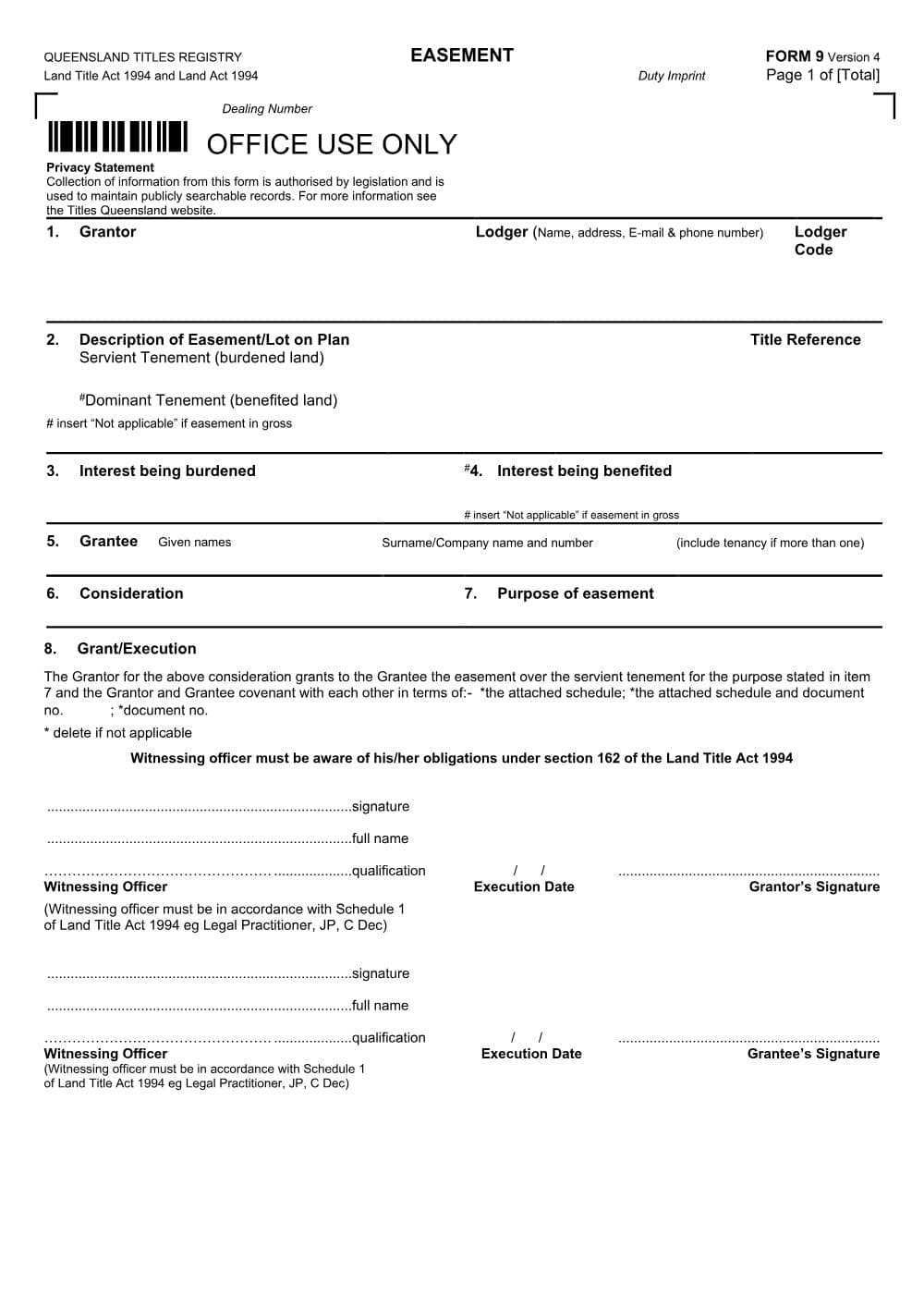
Form 9 is the Titles Queensland instrument for granting a registered easement over Queensland land. It covers rights of way, drainage easements and the like, for another lot or a public utility provider.
PDF from Titles Queensland's website.
DraftOur fillable copy of this form has not been through editorial review yet. Check it against Titles Queensland's current form before you rely on it.
- Format
- Word (DOCX)
- Category
- Land titles form
- Form number
- Form 9
- Version
- ve230c80b
- Last updated
- 26 October 2026
Land Title Act 1994
For law practices: this form maps to the published matter-field vocabulary, so your practice management system fills it from your matter data - on your own machine. Practice management systems can fetch and assemble it through the document assembly API.
What Form 9 is for
An easement over a lot, or part of a lot, can only be created by registering an instrument of easement, which must state the nature and terms of the easement and the land benefited and burdened (Land Title Act 1994 (Qld) s 82). It can be registered only if, for an easement over part of a lot, a plan of survey designating it is registered, and if it is signed by the owner (or lessee) of the land burdened and the owner of the land benefited (s 83). The benefited and burdened lots may have the same owner (s 86). An 'easement in gross' has no benefited lot and is granted to a public utility provider such as a local government (Land Title Practice Manual (LTPM) [9-2180]). Form 9 is the approved instrument.
When you need it
- One owner is granting a neighbouring lot a right of way, drainage, services or similar right over their land.
- An owner of two lots is granting an easement from one of their lots to the other (s 86).
- A local government or other public utility provider is taking an easement in gross, for example for sewerage or electricity.
- A court has ordered a statutory right of use under section 180 of the Property Law Act 2023; the easement is usually registered by a plan and a Form 9 with the order deposited (LTPM [9-2050]).
How to fill it in
- 1
Lodger panel and Item 1: grantor
Complete the lodger details. Insert the full name of the grantor: the registered owner of the burdened lot or the lessee of a freehold lease, with any capacity such as trustee or personal representative. All tenants in common should join in one easement. A minor cannot be a grantor (LTPM [9-4020]).
- 2
Item 2: description of easement and land
For the burdened land, insert the easement description for an easement over part of a lot (for example 'Easement A on SP 145897'), or just the lot description for an easement over the whole lot, with the title reference. For the benefited land insert the benefited lot, or 'Not applicable' for an easement in gross.
- 3
Items 3 to 5: interests and grantee
Item 3 is the interest burdened (for example 'Fee Simple' or 'Lease No. [number]'). Item 4 is the interest benefited, or 'Not applicable' for an easement in gross. Item 5 is the full name and tenancy of each grantee for each benefited title.
- 4
Items 6 and 7: consideration and purpose
Insert the monetary or other consideration, and a short description of the purpose, such as 'right of way' or 'drainage'. If that is not possible, refer to the attached schedule of covenants and description of use.
- 5
Item 8: grant and execution
Attach the covenants (on a Form 20 Schedule or by reference to a registered standard terms document) and select the option that applies. The grantor and grantee each sign before a witness listed in Schedule 1 of the Land Title Act 1994.
Filing, lodging and service
- For an easement over part of a lot, the survey plan (or explanatory format plan) showing the easement must be registered before, or lodged with, the Form 9. This is not needed for an easement over the whole of a lot (s 83(1)(a); LTPM [9-2020]).
- Deposit a Form 18 General Consent from every affected lessee of the burdened lot (LTPM [9-2082]). An easement giving access to a lot from a constructed road needs planning body approval (LTPM [9-2080]).
- Lodgement fees are payable and a duty notation is required (LTPM [9-2020]). Check the fee with the Titles Queensland fee calculator.
- Lodge by post to Titles Queensland, GPO Box 1401, Brisbane Qld 4001, or through eLodgement if you are a registered industry user. Form 9 is not on the list of instruments available through eConveyancing.
Common mistakes
- The purpose must be acceptable and precisely defined. The LTPM notes that 'view' and 'environmental' purposes are frequently attempted but not acceptable (LTPM [9-0040]).
- An easement that is to take effect at a future date cannot be registered (LTPM [9-0050]).
- Titles Queensland publishes two Form 9 checklists, one for standard easements and one for easements in gross, on its forms page.
Frequently Asked Questions
Do I need a survey plan to register an easement in Queensland?
For an easement over part of a lot, yes: a registered survey plan or explanatory format plan designating the easement is required before the Form 9 can be registered (s 83). An easement over the whole of a lot does not need one.
Can I grant an easement over my own land to my other lot?
Yes. The Land Title Act 1994 allows an easement to be registered even if the benefited and burdened lots have the same registered owner (s 86).
What is an easement in gross?
An easement with a burdened lot but no benefited lot, granted to a public utility provider such as the State, a local government or an authorised utility, for purposes such as access, drainage, sewerage or electricity (LTPM [9-2180]). In Form 9, insert 'Not applicable' for the benefited land and interest.
Checked against the official sources on 26 October 2026
- Land Title Act 1994 (Qld) ss 82, 83, 86 and Schedule 1
- Land Title Practice Manual Part 9 - Easement
- Titles Queensland - Form 9 Easement (version 4)
- Titles Queensland - Titles Registry forms (Form 9 checklists)
- Titles Queensland - eConveyancing available instruments, exclusions and exemptions
- Titles Queensland - Fee calculator
General information about the form, not legal advice about your matter. Rules and forms change: if anything here differs from the court or agency's current instructions, theirs apply.
More from Titles Queensland
Amendment (Form 13)
Form 13 (Amendment) is the Titles Queensland form to amend a registered lease, easement, mortgage, covenant, profit a prendre or building management statement. It can extend a lease.
Caveat (Form 11)
Form 11 is the Titles Queensland caveat that a person claiming an interest in Queensland land lodges to stop other dealings being registered on the title. Word and PDF versions are available.
Covenant (Form 31)
Form 31 is the Titles Queensland form for registering a statutory covenant over a Queensland lot in favour of the State, a State entity or a local government.
Declaration (annexure) - electronic version (Form 20)
This Form 20 is the Titles Queensland statutory declaration annexure, in a type-in electronic version. It gives declared evidence with a Land Registry form but must still be signed on paper before a witness.
Foreign ownership information (Form 25)
Form 25 is the Titles Queensland form a foreign person uses to notify the Foreign Ownership of Land Register when acquiring an interest in Queensland land.
General consent (Form 18)
Form 18 (General consent) is the Titles Queensland form a third party, such as a mortgagee or lessee, signs to consent to another instrument being registered. It applies to a Queensland title.